Tanegashima Space Center
5 Centimeters per SecondTanegashima Space Center is both a working launch site and a charged point of memory in Takaki Tohno’s story. Its rockets make the island visible on a vast scale, yet the launches also sharpen the distance between Takaki’s years there and his later life in Tokyo: what once filled the sky above him eventually reaches him as an image on a television screen.
Setting and Launches
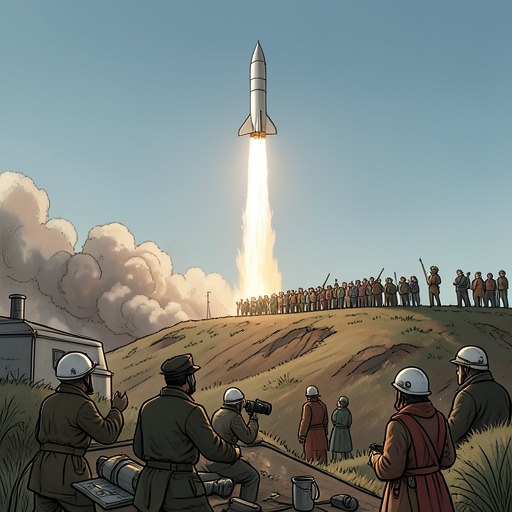
One launch on Tanegashima turns the familiar island atmosphere into a scene of overwhelming force. The cicada chorus falls silent; then a rocket rises from a distant hill, its nozzle flame whitening the observer’s vision. The rocket climbs through evening clouds as the air trembles, while a white smoke trail spreads across the sky and divides the setting sun into bands of light and shadow. The launch is brief, but its effects seem to reach beyond the visible ascent: even after the rocket disappears into the clouds, its echoes linger.
The later account identifies Tanegashima Space Center as the source of an H-IIA launch. The broadcast shows the rocket leaving the center in enormous flames, then follows it upward through footage shot with a super-telephoto lens and a camera mounted on the rocket’s body. Together, the scenes place the center within the island’s everyday landscape while also showing how a launch carries that landscape out of view.
Takaki’s Memory of the Island
Takaki’s first launch, seen when he was seventeen, is inseparable from the girl standing beside him: Kanae Sumida, a lively, deeply tanned surfer who had grown attached to him. Recalling the moment years later, he remembers not only the ascent but the emotional sequence around it: Kanae’s attempt to tell him she loved him, his awareness of his own feelings, and his inability to act. The launch remains bright in memory, but that brightness does not erase the hurt and resignation that followed.
When Takaki later leaves Tanegashima for university in Tokyo, he shares his departure time with only Kanae. At the small airport, she cries through their halting conversation and smiles when they say goodbye. The launch and the farewell thus belong to the same remembered island life: one moment sends a rocket upward, while the other marks Takaki’s departure from the place where his adolescence unfolded.
The Launch Seen from Tokyo
At summer’s end, Takaki watches a report of an H-IIA rocket rising from Tanegashima Space Center in his humid Tokyo apartment. The footage gives him a view of the island receding beneath the rocket, including Nakatane, where he spent his high-school years, and the coastline. The mediated image briefly returns the island to him, but it also makes clear that he is no longer there. His parents have moved to Nagano, and he thinks of Tanegashima as a place he passed through rather than as his current home.
The launch has a further, practical connection to his present: the satellite being carried into space will support mobile communications, so the event is not wholly separate from his work. Yet the connection only heightens his sense of distance. The rocket travels outward from a place he once knew; Takaki watches from Tokyo, aware that his life has carried him far away.
Place, Distance, and Belonging
The center’s significance comes less from any description of its facilities than from the contrast its launches create. In the island scene, rocket, smoke, sky, and sound overwhelm ordinary perception; in Tokyo, the same kind of ascent arrives as a news clip watched beside a beer in a closed-up apartment. The change in scale is also a change in intimacy: the launch is no longer a shared present but an image that reopens memories of Kanae and of Takaki’s years on the island.
Tanegashima Space Center therefore anchors a recurring tension between movement and belonging. Its rockets depart, while Takaki’s memory returns to the people and landscapes left behind. The site links the physical island to a life now elsewhere, making the spectacle of ascent inseparable from the quieter recognition of separation.